



























Probes and shovels


Probes and shovels: indispensable avalanche gear for off-piste safety
When skiing and snowboarding off-piste it’s about adventure, freedom and enjoying untouched powder. But this adventure also brings dangers. Avalanches are one of the biggest risks in unprepared terrain. That is why it’s crucial not only to have an avalanche transceiver, but also a probe and a shovel. These three items together form the essential avalanche safety kit. In this article you can read all about probes and shovels: what they are, how they work, why they are important, and what to look for when choosing the right model.
What is a probe?
An avalanche probe is an extendable pole used to locate a person buried under the snow after they have been pinpointed with an avalanche transceiver. The probe helps determine the exact position and depth of the victim. This is crucial for targeted and fast digging.
Probes are typically made of aluminium or carbon and consist of multiple sections connected by a cord. By pulling the cord or snapping it into place, you quickly extend the sections into one long, sturdy probing pole. A standard probe is between 240 and 320 cm long.
How do you use a probe?
Once an avalanche transceiver has brought you within a few meters of the victim, turn off the transceiver and take the probe. You insert the probe vertically into the snowpack, each time a few centimeters from the previous insertion, in a systematic pattern. This is called "grid probing."
As soon as you feel something hard, for example a ski, snowboard or the body of the buried person, you know where to dig. The depth markings on the probe indicate how deep the victim lies. With that information you can start digging quickly and efficiently.
Why is a probe important?
Without a probe you don’t know exactly where a buried person is. Although an avalanche transceiver brings you close, the precise location without a probe is often difficult to determine, especially in deep snow. Digging inaccurately wastes precious time and energy, while a victim’s chances of survival drop rapidly after 15 minutes.
The probe prevents random digging and thus increases the speed and effectiveness of the rescue. In a situation where every second counts, this can make the difference between life and death.
What is an avalanche shovel?
An avalanche shovel is a compact, sturdy shovel designed to remove hard snow after an avalanche. The shovel is lightweight but strong enough to dig through dense, compacted snow layers. Like the probe, the shovel is an essential part of your avalanche gear.
Avalanche snow is often much harder than fresh snow. Due to the pressure of the snowpack and the impact of the avalanche, the snow becomes a kind of compact mass that you cannot remove with your hands. A simple plastic shovel is not suitable for this – a good shovel should be made of aluminium or similar material.
How do you use a shovel during a rescue?
Once the probe contacts the victim, start digging from the side of the location. Dig at a diagonal angle toward the place where the probe touched the victim. This prevents accidentally digging onto the victim and ensures a more efficient excavation.
It’s important to work as a team. Several people can form an assembly-line system where the front person digs and the others pass the snow back. A well-coordinated approach greatly increases the speed of the rescue.
Why is a shovel indispensable?
Even if you find someone quickly with your transceiver and probe, you can do nothing without a shovel. Digging with your hands is ineffective and dangerous. You waste time, become exhausted and may cause more instability in the snow.
An avalanche shovel enables you to work purposefully, quickly and safely. Without a shovel a successful rescue is virtually impossible. That is why every off-piste skier or snowboarder should always carry a shovel — and know how to use it.
Important features of probes
When choosing an avalanche probe there are several things to consider:
-
Length
Shorter probes (e.g. 240 cm) are lighter and more compact but less suitable for deep snow. Longer probes (e.g. 300 or 320 cm) offer more reach, especially in high alpine terrain. -
Material
Aluminium is strong and relatively light. Carbon is even lighter but often more expensive. Both are suitable; the choice depends on your preference for weight and budget. -
Speed of setup
Choose a model with a fast locking system so you don’t lose time in emergencies. -
Depth markings
Most probes have markings to see how deep the victim lies.
Important features of shovels
When choosing an avalanche shovel there are also key points:
-
Material
Aluminium is the standard. Plastic shovels are light but not strong enough for avalanche snow. -
Shaft
An extendable shaft gives more leverage and prevents you from having to bend too far. -
Blade shape
A curved blade shovels more easily. Some models have holes for use as a snow anchor or stretcher. -
Modular functions
Some shovels can be converted into an ice axe or are suitable for snow profiles.
Practice and training
Owning a transceiver, probe and shovel is not enough. You must practice regularly to be able to act quickly and effectively in a real emergency. During avalanche training you learn how to use your gear, how to search, probe and dig in realistic scenarios. Exercises improve your technique and your response under stress.
You can practice with friends or take a course from a recognized mountain sports organization. The more you train, the better prepared you will be when it matters.
Combination sets and well-known brands
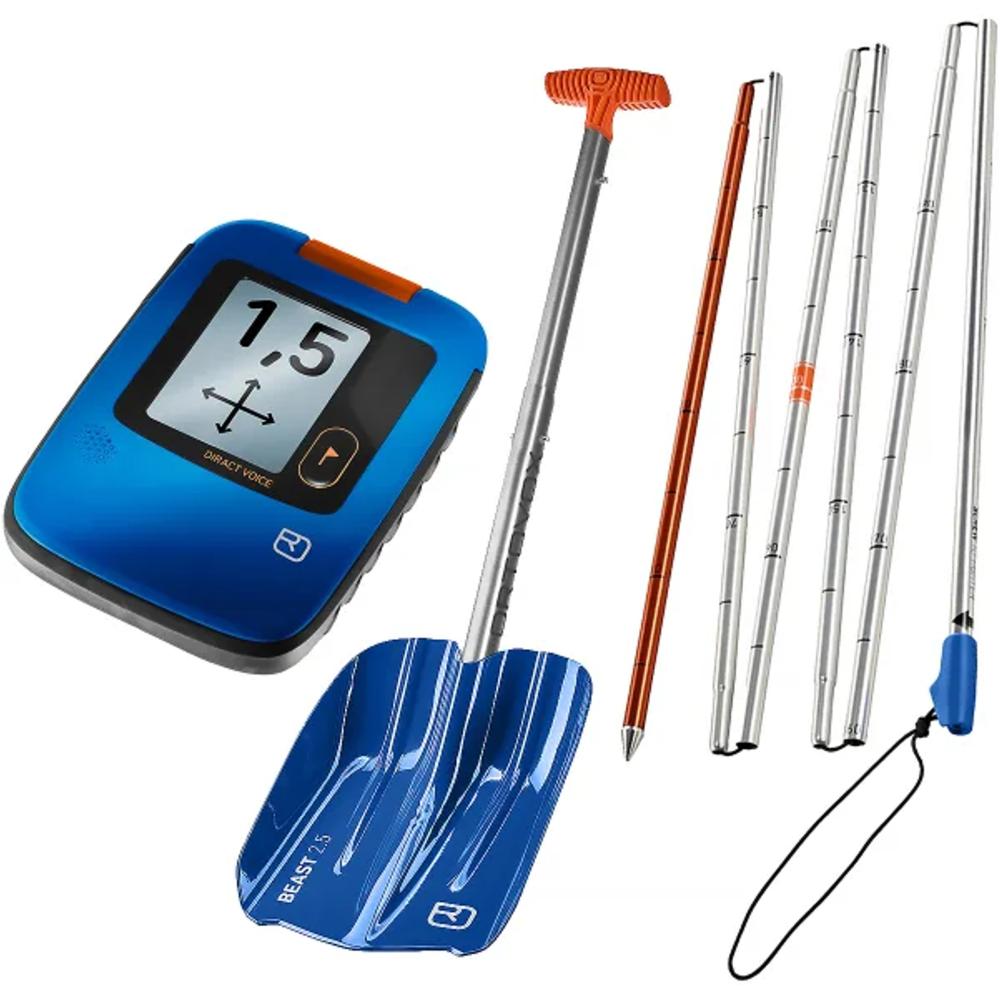
Many manufacturers offer complete avalanche kits with transceiver, probe and shovel. This is often more economical and ensures that all components are matched to each other.
Conclusion: probes and shovels save lives
If you snowboard or ski outside the beaten track, it’s not a question whether you need an avalanche probe and shovel, but when. In combination with a transceiver they form the holy trinity of avalanche safety. Without these tools you are powerless in an emergency.
Probes and shovels are compact, light and easy to carry in your backpack. They are not a burden — they are life-saving. Make sure you and your group always carry the complete kit and know how to use it. Because in off-piste terrain every second counts — and your preparation can make the difference between saving someone or being too late.