



























Snowboard backpack with Airbag
Snowboard backpack with airbag: extra safety in off-piste terrain
For snowboarders who venture off the beaten track, safety is crucial. Good equipment not only improves comfort but can also make the difference in critical situations. A snowboard backpack with airbag – also called an avalanche backpack – is specially designed to increase survival chances during an avalanche. In this text you will read everything about what a backpack with airbag exactly is, how it works, what to look for when buying, and which additional features make such a backpack indispensable for freeriders and off-piste snowboarders.
What is a snowboard backpack with airbag
A backpack with airbag is a special type of snowboard or ski backpack that is equipped with an integrated airbag system. These backpacks are intended for use in avalanche-prone terrain. When an avalanche occurs and you are carried away as a snowboarder, you pull a handle or cord. This inflates the airbag in a fraction of a second with air or gas. The inflatable air cushions increase your volume, making it less likely that you will end up under the snow. This increases the chance of staying on top of the avalanche, which significantly improves survival odds.
Why use an avalanche backpack
Snowboarding outside the pistes, also called freeriding, carries risks. Snow conditions are less predictable, and there is always a chance of an avalanche. Although an avalanche backpack does not guarantee survival, it does give you a greater chance of remaining above the snow mass. In addition, a backpack with airbag makes it easier for rescue services to locate you, especially when combined with other avalanche equipment such as a transceiver, probe and shovel.
The airbag is only one of the safety tools you use on off-piste trips. It remains essential to have knowledge of the terrain and snow conditions and to never go off-piste without experience or guidance.
How a backpack with airbag works
The mechanism of a backpack with airbag is simple but effective. Inside the backpack is an air cushion that is compactly folded. When you pull the activation handle, the airbag is inflated in less than three seconds. This happens via a gas cartridge or an electronic fan, depending on the type of system.
There are two main types of airbag systems: gas cartridge-activated systems and electric systems. A gas cartridge uses a carbon dioxide or nitrogen cartridge. These systems are reliable and lightweight, but a cartridge must be replaced or refilled after each activation. Electric systems, such as those from Alpride or JetForce, run on batteries and can be activated multiple times without replacing parts. They are a bit heavier but easier to test and reuse.
Important features of a snowboard airbag backpack
Besides the airbag system, a good snowboard backpack with airbag must also meet the requirements of a functional backpack. Comfort and fit are crucial. The backpack must sit firmly against your back and not shift during boarding. Many models have adjustable shoulder straps, a chest strap and a hip belt for extra stability.
The layout of the backpack also plays a role. There must be enough space for your avalanche equipment (shovel and probe), extra clothing, food, drink and other necessities for a day in the mountains. Some backpacks have a dedicated compartment for avalanche equipment so you can access it quickly in an emergency. In addition, there are attachment systems for your snowboard, helmet or skis.
Contents and size of the airbag backpack
Avalanche backpacks are available in different sizes, usually ranging from 18 to 35 liters capacity. Which size is best depends on your personal needs. For short day trips a compact 18-25 liter backpack is often sufficient. If you are out for longer or want to carry more gear, choose a larger variant of 30 liters or more.
Keep in mind that the airbag system itself also takes up space. The usable volume of a backpack with airbag is therefore slightly smaller than that of a regular snowboard backpack with the same liter capacity.

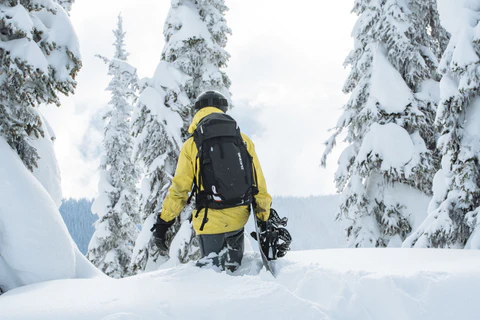
Weight and carrying comfort
A backpack with airbag typically weighs more than a regular snowboard backpack due to the built-in system. Most models weigh between 2.5 and 3.5 kilograms, including the gas cartridge or battery. Although this extra weight is noticeable at first, modern models are designed so that the weight is well distributed across your back and shoulders.
When choosing a airbag backpack it is important to pay attention to carrying comfort. Good padding, ergonomic design and adjustable straps make a big difference, especially if you do long tours or move through difficult terrain.
Maintenance and reuse
A snowboard backpack with airbag requires some maintenance, especially if you have used it or want to test it. For gas-powered models you must replace or refill the cartridge after activation. Electronic systems must be recharged and possibly reset after use. It is important to check that everything works before the season. Most manufacturers recommend performing an annual test so that you are familiar with activating the airbag and know that the system functions correctly.
Combining safety with technology
More and more manufacturers combine airbag technology with other smart features. Think of GPS trackers, built-in avalanche transceivers, or compatibility with avalanche beacons. Some avalanche backpacks are equipped with Bluetooth and apps, allowing you to manage battery status and system updates via your smartphone. Such features add extra value for advanced freeriders and mountain guides who always want to be able to rely on their gear.
Regulations and transport of backpacks with airbag
If you travel with a backpack with airbag, it is important to know the rules around transport. Gas cartridges in particular can cause problems on flights. Check with your airline in advance whether you may take an airbag backpack with you and whether there are special conditions attached. Electric systems are usually easier to transport because they do not contain pressure vessels.
Local rules may also apply on site. In some areas you are only allowed to go off-piste with approved airbag systems. Always check the local regulations before you head into the terrain.
Conclusion: snowboard safe with a backpack with airbag
Snowboarding off-piste is beautiful but carries risks. With a snowboard backpack with airbag you are better prepared for the unexpected. These backpacks offer extra protection in avalanches, increase your survival chances and combine smart technology with practical storage space and carrying comfort.
When purchasing, pay attention to factors such as activation type, capacity, weight, fit and compatibility with other safety gear. Choose a model that fits your use and experience. An avalanche backpack is not a replacement for knowledge or training, but it is an important addition to a responsible approach in the mountains.